
Ever felt like you’re just guessing out on the water? You’ve got the best gear and the perfect spot, but the fish just aren’t cooperating. You glance at a jumble of numbers and lines, wondering if ‘slack tide’ is a good thing or a bad thing, and if you should be fishing the incoming or outgoing push. The truth is, mastering louisiana tide charts for fishing isn’t just helpful-it’s the secret weapon that separates a good day from an epic one in our legendary coastal marshes.
Forget the confusion. This isn’t some dry, scientific manual. This is a captain’s guide, forged from over 25 years of chasing giant redfish and speckled trout. I’m pulling back the curtain to show you exactly how I read the water’s rhythm to predict where the fish will be and, more importantly, when they’ll be feeding. We’ll break down the terminology and translate that chart data into a real-world strategy for success.
Get ready to turn an average trip into an unforgettable adventure. By the end of this guide, you’ll confidently plan your trips around the most productive tides, understand how water movement triggers the bite, and start putting more fish in the boat. It’s time to stop hoping and start hunting. Let’s get you on the fish!
Key Takeaways
- Understand why moving water is the secret to the Louisiana marsh, acting as a dinner bell that triggers epic feeding frenzies.
- Learn to read a tide chart like a veteran guide, instantly identifying the peak bite windows based on tidal height and water flow.
- Master the different strategies for incoming vs. outgoing tides, and see how the pros use Louisiana tide charts for fishing to consistently find trophy redfish and trout.
- Discover how to use wind and weather to your advantage, predicting how these factors will change the tide and concentrate baitfish for a successful trip.
Why Tides are the Secret Weapon for Louisiana Inshore Fishing
Forget the latest high-tech lures and secret GPS coordinates for a moment. The single most powerful weapon in your arsenal for an epic day on the water is understanding the tide. Here in the vast Louisiana marsh, moving water is the lifeblood-the powerful engine that drives the entire ecosystem. While the celestial mechanics creating them are complex (Wikipedia offers a comprehensive overview of tides), their effect on our fishery is beautifully simple: they tell the fish when it’s time to eat. A day with strong tidal movement is a world apart from a dead, slack tide. One is an all-you-can-eat buffet for giant redfish and speckled trout; the other can feel like a ghost town. Learning to read louisiana tide charts for fishing isn’t just a helpful tip-it’s the key to unlocking consistent success.
The ‘Dinner Bell’: How Water Movement Gets Fish Biting
Imagine a giant dinner bell ringing across the marsh-that’s a rising or falling tide. This powerful current acts like a natural conveyor belt, flushing vulnerable bait out from their hiding spots in the dense cordgrass. This moving water creates an irresistible, can’t-miss opportunity for hungry predators. Here’s why it’s so effective:
- The Ambush is Set: Bull reds, hungry speckled trout, and flounder instinctively know where to be. They stack up at the mouths of drains, points, and cuts, waiting to hammer the shrimp and baitfish being swept into their path.
- Energy to Burn: Moving water is richer in dissolved oxygen. This biological boost revs up a fish’s metabolism and triggers aggressive feeding behavior. They aren’t just eating; they’re actively hunting.
This is the magic window when the explosive feeding frenzies you dream about ignite. The fish are active, concentrated, and ready to strike nearly anything that moves.
Louisiana’s Marsh: A Unique Tidal Environment
Our tidal environment isn’t like the wide-open beaches of other coasts. Here, the entire force of the Gulf’s tide is funneled through an endless labyrinth of bayous, cuts, and channels. This unique geography acts like a nozzle on a hose, concentrating the flow and creating predictable, high-action hotspots. A seemingly insignificant six-inch drop in water can completely drain a shallow backwater pond, forcing every last baitfish through a single, narrow exit. That pinch point becomes a five-star restaurant for predators. This is precisely why mastering louisiana tide charts for fishing transforms your approach from hopeful guessing to strategic hunting. You’re no longer just looking for fish; you’re predicting exactly where the buffet line will form and getting there first.
How to Read a Louisiana Tide Chart Like a Pro
Don’t let a chart full of numbers intimidate you. Think of it as the ultimate cheat sheet for your next trip into Vermilion Bay. Mastering louisiana tide charts for fishing is the difference between a good day and an epic adventure where you’re battling giant bull reds all day long. Let’s break it down so you can use it like a seasoned pro.
Decoding the Key Elements: High, Low, and Everything In-Between
At first glance, it’s just a grid. But every number tells a story about where the fish are and what they’re doing. Imagine you’re looking at a chart for a hotspot like Cypremort Point.
[Image: Sample tide chart for Cypremort Point, LA, showing the wavy line of tide heights, with clear labels for high and low tide times and heights for a specific day.]
These figures aren’t just guesses; they are precision-engineered using data from the most reliable sources, like the official NOAA Tides and Currents predictions, which provides the foundation for most charts. Here’s what to focus on:
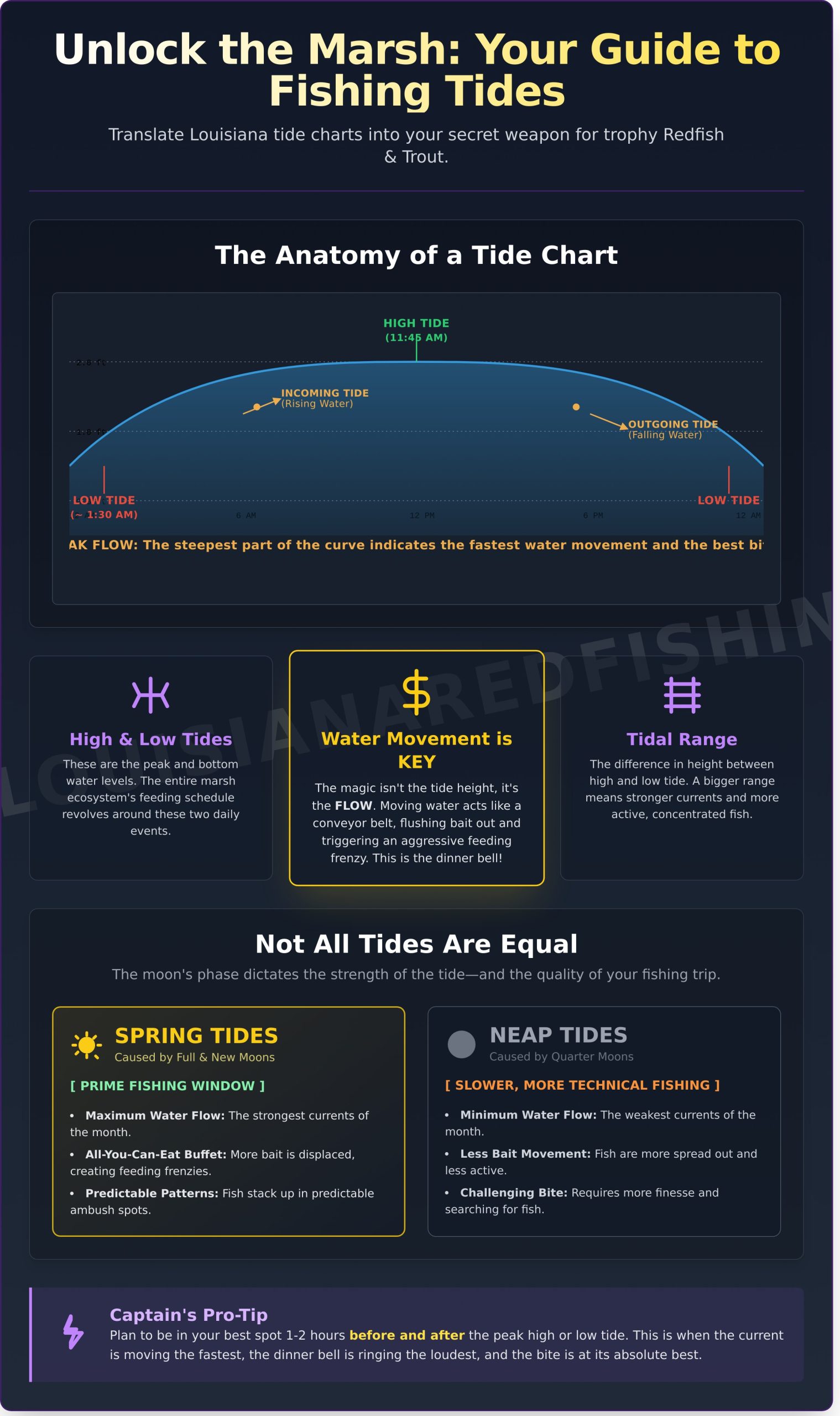
- High & Low Tide: These are the absolute peak and bottom of the water level. The entire feeding schedule of the marsh revolves around these two events.
- Tide Height (in feet): This tells you how much water is actually present. A low of 0.2 ft and a high of 1.8 ft means a significant push of water is coming.
- Time: The exact moment the high or low is predicted to occur. Your plan should be built around being in the right spot before these peak times.
- Date: The most basic element, but crucial for planning that trip weeks or even months in advance.
Understanding Tidal Range: Spring Tides vs. Neap Tides
The “secret sauce” is the tidal range-the difference in height between high and low tide. A bigger range almost always means a better bite. This is dictated by the moon.
Spring Tides happen during a new or full moon when gravitational forces align, creating supercharged currents and a huge tidal range. This is the dinner bell. All that moving water stirs up bait, triggering an aggressive feeding frenzy. These are the days you dream of.
Neap Tides occur during quarter moons. The gravitational pull is weaker, resulting in a small tidal range and lazy, slow-moving water. The bite can be tough. When you have a choice, always pick a day with a big tidal swing for your best shot at success.
What is ‘Slack Tide’ and Why It’s Usually a Waste of Time
In between the rush of an incoming or outgoing tide, there’s a brief pause where the water barely moves. This is slack tide, and for an angler, it’s often the dead zone. When the current dies, the bait stops moving, and predator fish take a break. Don’t waste your best lure during this lull. Use this time to re-tie your leader, move to your next spot, or grab a sandwich. The action will fire back up the moment the water starts ripping again!
Incoming vs. Outgoing Tide: The Great Debate for Redfish & Trout
Ask ten Louisiana anglers which tide is best, and you might get ten different answers. But here’s the truth: there is no single “best” tide. The real secret to using louisiana tide charts for fishing isn’t just knowing when the tide moves, but understanding how to use that movement to your advantage. Both incoming and outgoing tides can produce an epic day on the water, but they create entirely different scenarios. Once you grasp the basic science behind tides, you can turn that knowledge into your ultimate secret weapon.
The Case for the Falling (Outgoing) Tide
For many local veterans, a strong falling tide is the dinner bell. This is when the marsh literally drains, pulling countless shrimp, crabs, and baitfish out of the protective grasses. This tidal flow creates a concentrated buffet line at the mouths of drains, cuts, and bayous. Giant redfish stack up at these ambush points, waiting for an easy meal to be delivered right to them. The water clarity often improves as it filters out of the marsh, making for an explosive bite.
When to Fish the Rising (Incoming) Tide
Don’t sleep on the rising tide! As clean, salty water from the Gulf pushes into the estuary, it brings hungry predators with it. Redfish will use the higher water to patrol shallow flats and poke along flooded grass lines, hunting for crabs and other prey. This is a prime opportunity for sight-fishing in clear ponds, where you can watch a bull red charge your lure. On an incoming tide, fish will often position themselves on the down-current side of points and oyster reefs, facing the flow and waiting for bait to be swept past.
Matching the Tide to Your Target Species
Different species react to tidal flow in unique ways. Your success depends on putting the right bait in the right place at the right time. Here’s a quick guide to get you started:
- Redfish: They are structure-oriented ambush predators. Target the mouths of drains on a hard falling tide. On a rising tide, look for them pushing water on shallow flats.
- Speckled Trout: Specs often prefer moving water over structure. Fish for them on points, over submerged oyster reefs, and along current rips where bait is being swept by on either tide.
- Flounder: These masters of camouflage lie flat on the bottom, waiting for a meal. They almost always position themselves facing into the current, so cast your bait up-current and let it drift naturally over their ambush zones near drains and drop-offs.
Advanced Tidal Strategies: Wind, Weather, and Solunar Theory
Ready to move from apprentice to master? A printed tide chart is your starting point, but a true marsh veteran knows it’s just one piece of the puzzle. The most accurate louisiana tide charts for fishing are useless if you can’t read the real-world conditions that can rewrite the script in a hurry. This is where experience separates the pros from the pack.
How a Strong Wind Can Wreck a Perfect Tide Chart
In Louisiana, the wind is the ultimate wild card. A screaming 20-knot north wind, especially after a cold front, can literally blow the water out of a shallow bay. This creates an abnormally low tide that can leave you high and dry, but it also concentrates giant reds into deeper holes. Conversely, a hard south wind acts like a bulldozer, pushing Gulf water into the marsh and holding the tide high for hours, completely stalling the outgoing flow you were counting on. You must check the wind forecast and be ready to adapt your plan on the fly.
Using Solunar Tables with Tide Charts
Think of solunar tables as a secret weapon for stacking the odds in your favor. Based on the moon and sun’s position, these tables predict major and minor feeding periods. While a tide chart tells you when the water will move, a solunar table suggests when the fish are most likely to feed. The magic happens when you align these two powerful forces. A major feeding period that overlaps with strong tidal movement is the recipe for an epic bite and the key to turning a good day into a legendary one.
Putting it All Together for an Epic Day
A captain’s pre-trip checklist isn’t just one chart; it’s a synthesis of data that paints a complete picture. Here’s how we find the action:
- Tide First: We identify the strongest incoming or outgoing flow for the day. This is our foundation.
- Wind Second: We analyze the forecast. Will the wind accelerate the tide, stall it, or muddy our target area? This dictates which banks and bayous will be fishable.
- Solunar Last: We overlay the major feeding times onto our tidal window to pinpoint the absolute peak time to have lines in the water.
This is how you turn a good day into an unforgettable adventure. It’s the difference between hoping for a bite and knowing exactly where the thrill is waiting. Tired of guessing? Fish with a guide who lives by the tides.
Top Tide Charts for Vermilion Bay and South Louisiana
You’ve learned how to read the tides, now it’s time to find the best data. Knowing where to look is half the battle, and a reliable forecast is the foundation for an epic day on the water. While there are dozens of resources out there, a seasoned guide knows which ones to trust. Here are the go-to tools we use to plan our attacks on the giant bull reds of Vermilion Bay and beyond.
Our Go-To Tide Station: Cypremort Point, Vermilion Bay
For anyone fishing our home waters, the tide station at Cypremort Point is the single most important data source. It’s the heartbeat of the bay, providing the baseline prediction that dictates water movement throughout the surrounding marsh and bayous. We start every trip plan by analyzing this data, knowing it gives us the most accurate picture of the major and minor feeding windows.
Pro Tip: A guide’s real expertise comes from adjusting this raw data. Based on wind speed, direction, and our deep knowledge of the marsh, we can predict how the tide will behave several miles inland, where the fish are really hiding. That’s the kind of local insight that turns a good day into a legendary one.
Direct Link: NOAA Tide Predictions for Cypremort Point, LA
Reliable Websites and Apps for Louisiana Tides
Having the right app on your phone makes checking conditions a breeze. Whether you’re targeting Vermilion Bay, Calcasieu Lake, or the marshes around Hopedale, these are the best louisiana tide charts for fishing that you can count on. Arm yourself with the right information and get ready for the thrill of the chase.
- NOAA Tides & Currents: The official source. It’s the most accurate, no-frills data you can get. We trust it as our baseline for all trip planning.
- Tides4Fishing: A fantastic resource built for anglers. It includes solunar tables, bite-time ratings, and weather data all in one place, making it a powerful tool.
- US Harbors: Offers clean, easy-to-read charts and includes local weather and news. Their 7-day forecasts are great for planning your trip in advance.
These tools give you a powerful advantage, but nothing beats decades of on-the-water experience. When you’re ready to see how a pro puts this knowledge into action to limit out on Redfish and Speckled Trout, book your epic adventure with Captain Troy. He’s got you covered!
From Charts to Cheers: Your Louisiana Fishing Adventure Awaits
You now hold the keys to unlocking the full potential of Louisiana’s legendary inshore waters. Remember, the tide is your ultimate guide-its constant ebb and flow dictates exactly where hungry redfish and speckled trout will be feeding. Truly understanding the louisiana tide charts for fishing, and not just glancing at them, transforms a good day on the water into an unforgettable battle with trophy fish. It’s about casting with confidence and purpose every single time.
But reading the water is an art form perfected over generations. Why spend your precious time deciphering data when you can fish with a master who lives by it? Climb aboard with a 3rd generation, veteran Louisiana captain who has over 25 years of experience turning tidal knowledge into screaming reels right here in Vermilion Bay. We don’t just follow the tides; we anticipate them. Our mission is simple: we put you on the fish when they’re biting.
Stop studying and start experiencing the thrill. Let an expert handle the tide charts. Book your epic adventure today!
Your next giant redfish is just one tide away.
Frequently Asked Questions About Louisiana Tides
What is the best tide to fish for redfish in Louisiana?
Moving water is everything! A strong falling (outgoing) tide is the gold standard for targeting redfish. This current pulls baitfish, like shrimp and crabs, out from the marsh grasses, creating a natural buffet line at choke points and drains. Hungry bull reds stack up and ambush their prey. A strong incoming tide can also trigger an epic bite, especially on shallow flats, but for consistent action, you can’t beat a hard-falling tide.
How much does the tide typically change in the Louisiana marsh?
The tidal range in our coastal marshes is typically between one and two-and-a-half feet. While that might not sound like much, in our shallow-water paradise, it’s a game-changer. A single foot of water can completely drain a productive pond or flood a new flat, concentrating fish in predictable areas. This is why understanding the tide’s movement is absolutely critical for a successful trip and finding those giant redfish.
Does a full moon really make fishing better?
A full moon-and a new moon-creates stronger spring tides with higher highs and lower lows. This powerful water movement can definitely ignite an incredible feeding frenzy as bait gets flushed around aggressively. The one catch is that redfish may feed heavily at night under the bright moon. This can make the daytime bite tougher, but it also means the action is concentrated into intense windows when they decide to eat. It’s high-risk, high-reward fishing!
Can you still catch fish during a neap tide?
Absolutely! Don’t ever let a neap tide keep you off the water. While the weaker currents mean fish won’t be concentrated at choke points, it just calls for a change in strategy. During neap tides, we focus on structure like oyster reefs, rock piles, and deeper holes where fish hold tight. The bite might be more subtle, but with over 25 years of experience, we know exactly where to find them. The hunt is just different.
How far in advance can I check the tide charts for my trip?
The great thing about astronomical tide predictions is that they are incredibly accurate and can be checked a year or more in advance. This makes planning your epic adventure easy. However, remember that weather is the ultimate wild card. Strong north winds can blow water out of the marsh, while a hard south wind can push it in, overriding the prediction. Always check the louisiana tide charts for fishing a day or two before your trip to compare with the forecast.
What’s more important for fishing: the tide or the time of day?
In the Louisiana marsh, the tide is king. While an early morning bite at sunrise can be fantastic, a slack tide during that “golden hour” will almost always be out-fished by a strong moving tide in the middle of the afternoon. Moving water triggers feeding instincts-it’s that simple. We plan our entire charter around the tide’s schedule to ensure you are in the most productive spots when the dinner bell rings for the redfish.